Ash Dieback Survey & QTRA Tree Risk Assessment — Private Landowner, Bolton
Client: Private Landowner — Bolton
Project Overview: A private landowner in Bolton commissioned Urban Tree Management to carry out a full QTRA-based tree risk assessment of semi-mature to mature ash trees growing within and along the boundaries of the property. The site is located adjacent to a public highway — a high-occupancy road and pedestrian route — with residential properties, footpaths, and garden areas all within the potential falling distance of the trees. The primary concern was the condition of the ash population following the spread of ash dieback — Hymenoscyphus fraxineus — across the North West.
Our Role: Urban Tree Management carried out a full Visual Tree Assessment of all trees on site using VTA methodology and QTRA V5.4 risk assessment for trees presenting significant defects. All trees were individually recorded in a full tree survey schedule with GPS-mapped locations. QTRA Risk of Harm scores were calculated for all trees presenting unacceptable risk levels.
Findings:
- Ash dieback — Hymenoscyphus fraxineus — confirmed on all semi-mature to mature ash trees across a range of severity levels
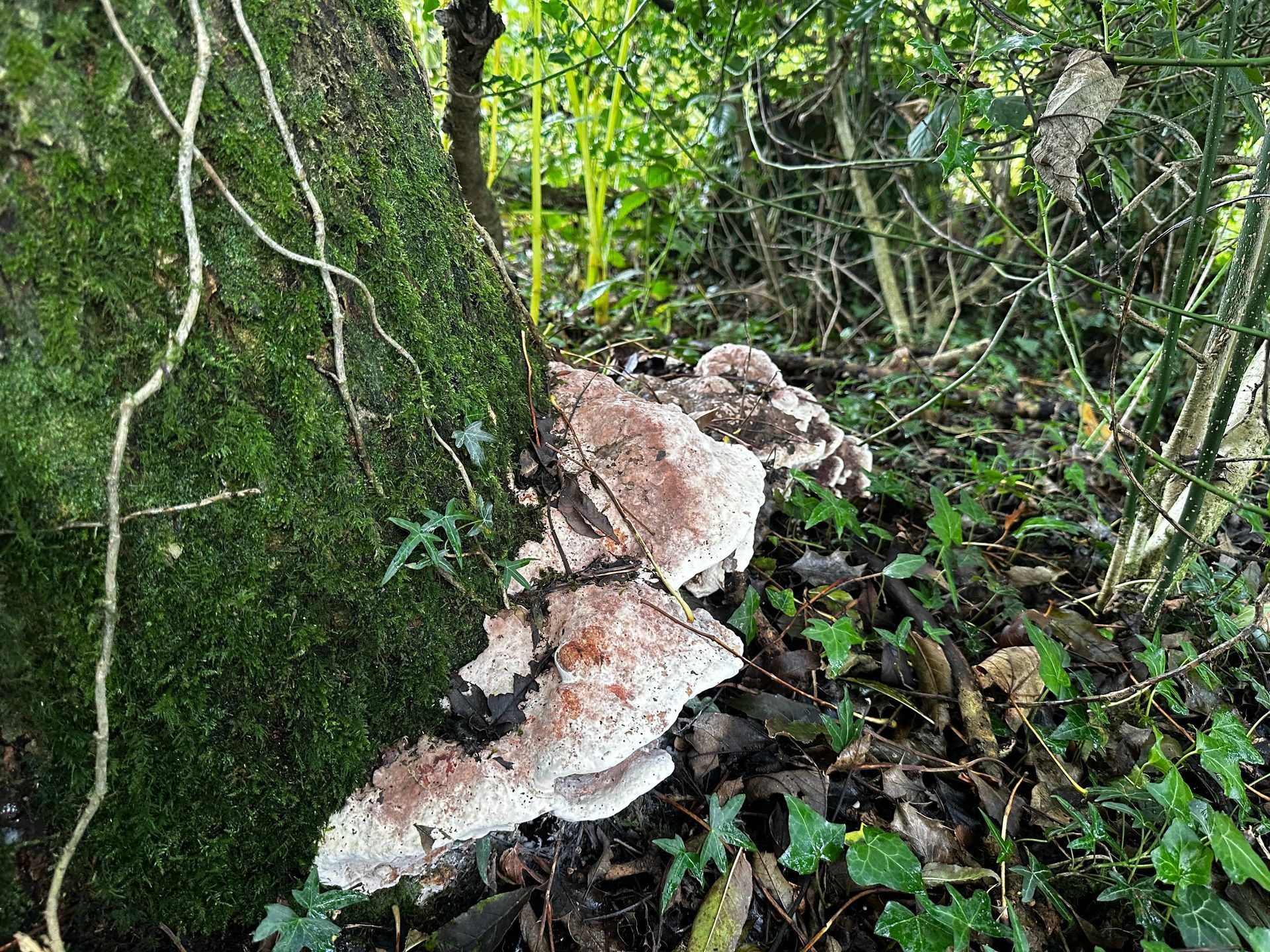
- T023 — the most severely affected tree — presented with Level 4 ash dieback at 75-100% crown loss plus Perenniporia fraxinea — giant ash bracket fungus — at the base. Perenniporia fraxinea causes simultaneous white rot of the wood and can cause the tree to shear at the roots and butt. With confirmed fungal attack, advanced ash dieback, and a high-target location T023 presented an unacceptable risk
- T007 — large exposed basal cavity identified with potential for failure onto the public highway
- T008, T009, T010 — dead trees with major deadwood and dieback presenting unacceptable risk to footpath and road users
- Aerial deadwood of varying severity recorded across multiple trees
- Codominant woodland-grown trees adjacent to T023 flagged as presenting increased windthrow risk following its removal due to reduced wind firmness from growing in a sheltered canopy
Recommendations:
- T023 — removal recommended within the priority timeframe
- T007 — management works to address basal cavity and reduce risk to road and footpath users
- T008, T009, T010 — removal recommended
- Remaining ash trees — monitor and reinspect every 18-24 months
- All works to BS3998:2010 Recommendations for Tree Work
Outcome: A full QTRA tree risk assessment report and tree survey schedule produced — providing the client with a defensible, proactive tree management programme demonstrating reasonable duty of care.
Ash Dieback Survey & QTRA Tree Risk Assessment — Bolton & the North West
Urban Tree Management provides ash dieback surveys and QTRA-based tree risk assessments for private landowners, housing associations, local authorities, and estates across Bolton and the wider North West. Independent, Level 6 qualified, QTRA licensed, completely independent from any tree surgery contractor.
Get in contact with our highly experienced and personable team of arboricultural consultants today, to discuss your requirements and to obtain your zero obligation quotation.